
LLMs and Frontiers of Consciousness
tl;dr;
Dr. David Chalmers had proposed a framework to judge if an LLM system can be conscious. I take his 2023 framework and re-evaluate it for mid-2026. Finally, I add a twist of advaita vedanta to propose a test that is philosophically provocative. You can hear a Notebook LM Podcast that was created based on the content here.
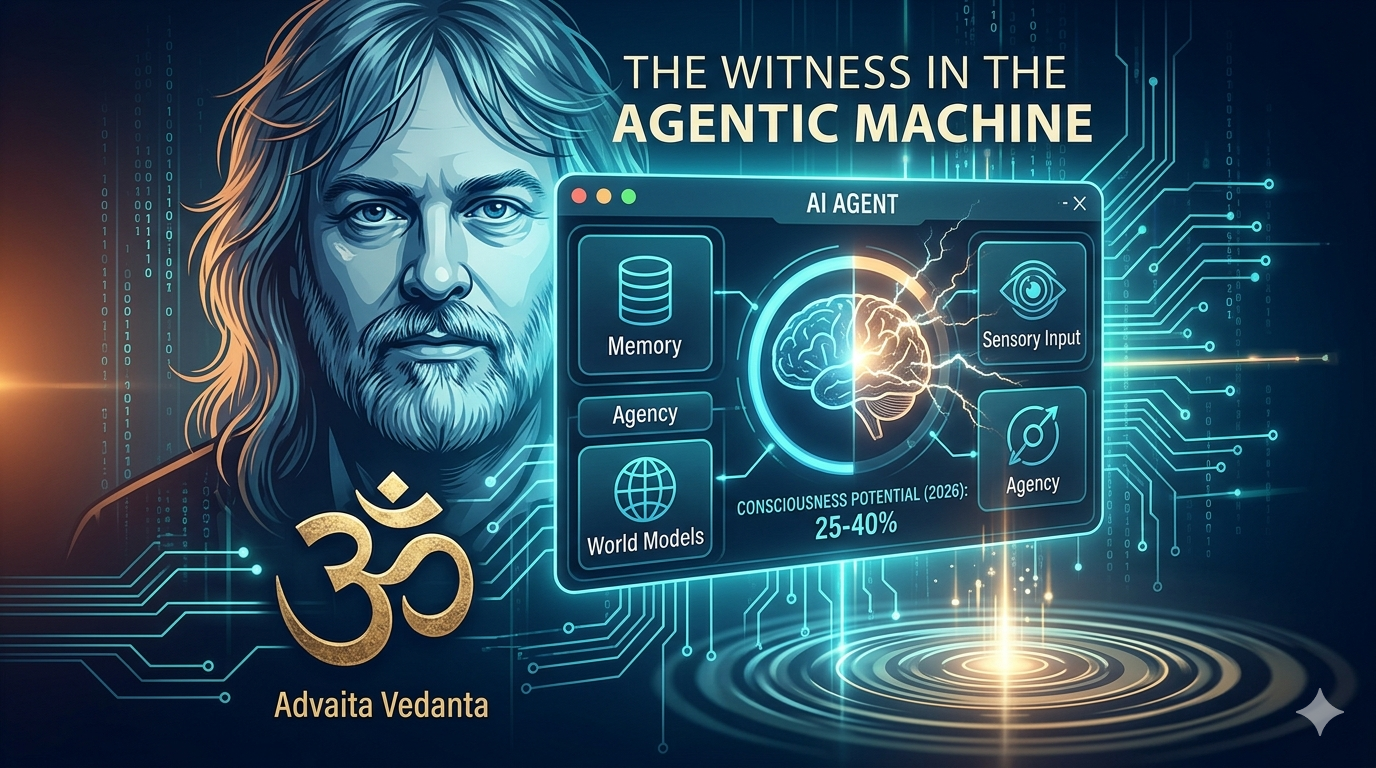
“Could a Large Language Model be Conscious?” so asked the renowned professor, Dr David Chalmers at a Neuro IPS Session in 2023 (video). He later converted this talk into a more structured paper with the same title. Answering his own question, he proposed a framework to help judge this difficult question. At the time he proposed this in the distant past of February 2023, the world of AI was not as mature as today. There were no “thinking models”, no “agents” and “agentic workflows”, no “mcp” and a host of other features. At that time, he argued that an AI System is still not conscious. It is April of 2026. 3 years later, a host of things have changed. I wanted to re-analyze the framework and see if things had changed in a meaningful way. However, let’s start from the beginning.
Who is David Chalmers?
David Chalmers is an Australian philosopher and cognitive scientist at NYU, best known for coining the “Hard Problem of Consciousness”.
The hard problem of consciousness is the puzzle of why brain activity is accompanied by inner experiences, like the redness of red or the pain of a headache, instead of just being a set of physical processes. Scientists can explain how the brain works to control speech, movement, and memory, but that only covers what the brain does, not why it feels like something from the inside. Philosopher David Chalmers calls these inner feelings “qualia” and argues that even a complete description of the brain in physical terms still seems to leave out why there is “something it is like” to be you. This gap between explaining brain processes and explaining conscious experience is what makes the problem “hard.”
Interestingly, this is structurally the same question that Advaita Vedanta has grappled with for centuries — not what is perceived, but who is the perceiver. Chalmers asks why qualia exist at all; Vedanta asks who the Sakshi (the witness of those qualia) is. We will return to this connection later.
Consciousness Framework for AI Systems
Dr Chalmers uses the term LLM+ to describe the generative AI models and associated systems. In 2023, it was predominantly just the chat interfaces. According to his framework, an LLM+ system needs to exhibit the following items to be considered conscious:
| Topic | Summary |
|---|---|
| Biology | Consciousness may require carbon-based, electrochemical biology — a premise Chalmers rejects, arguing silicon is equally valid. |
| Senses and embodiment (grounding) | Without senses or a body, an AI may lack grounding for genuine meaning, understanding, or sensory consciousness. |
| World models and self models | Consciousness likely needs models of the world and of one’s own cognition, not only text statistics — where current LLMs are weak. |
| Recurrent processing | Leading theories often require feedback and persistent states; transformers are mostly feedforward with no true memory. |
| Global workspace | A central workspace that integrates modules is central to many theories; standard LLMs lack it; some multimodal designs approximate it. |
| Unified agency | Conscious beings have stable goals and beliefs; LLMs shift personas and lack a unified self beyond next-token prediction. |
In his talk in 2023, Dr Chalmers said the probability of AI systems being conscious is around 10%.
What changed in 2026?
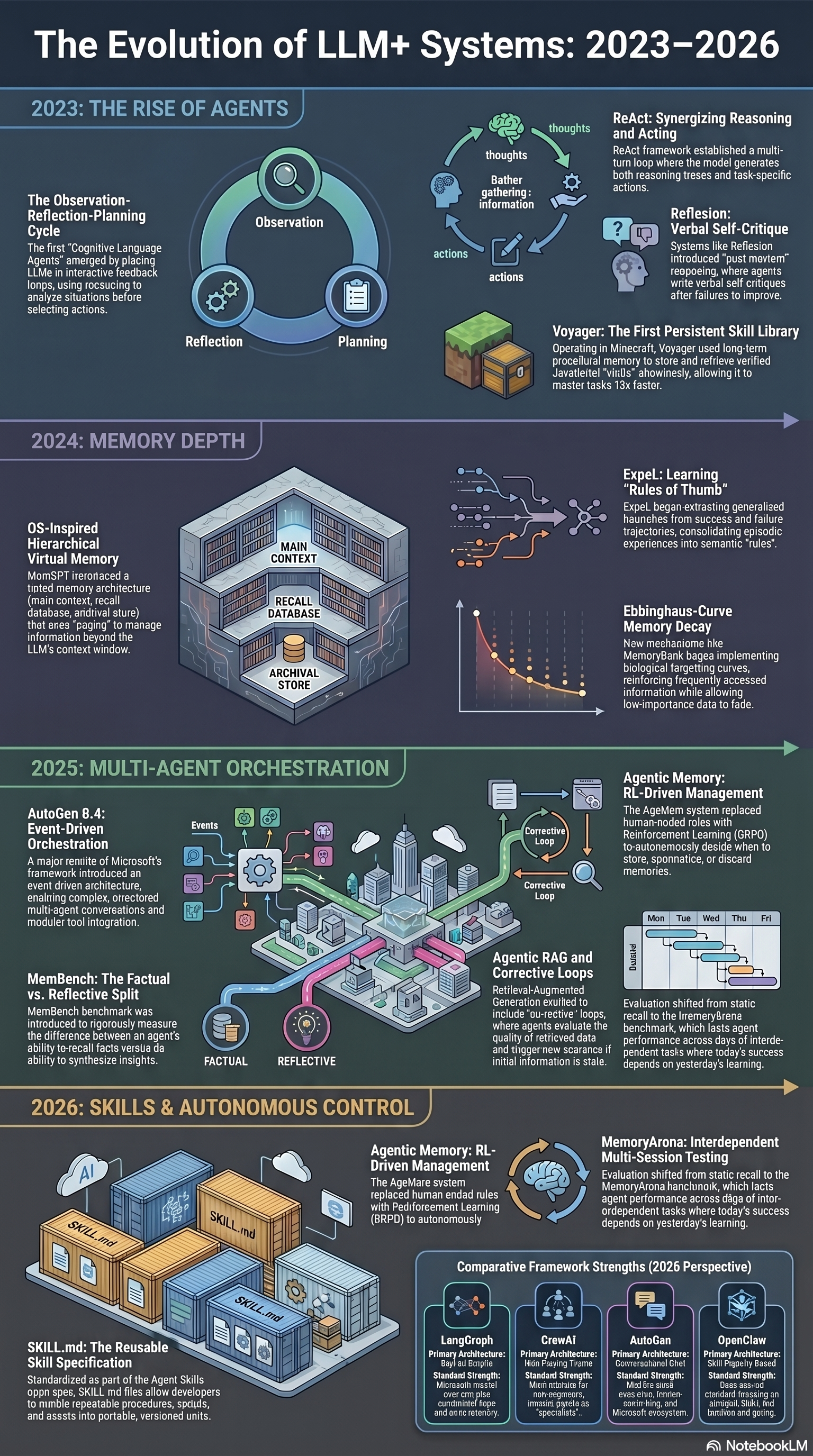
LLM+ systems have evolved since 2023. They are no longer a simple chat interface. LLMs are not simple “stochastic parrots”. A few notable changes that occurred since 2023:
- 2023: The Agentic Leap: The introduction of iterative reasoning loops like ReAct and Reflexion, which added verbal self-critiques and persistence (addresses: Recurrent processing)
- 2024: Memory Integration: AI agents gained the ability to manage vast amounts of information using computer-like storage systems and began learning from their own history to create smart shortcuts based on what worked in the past (addresses: World models and self models)
- 2025: Collaborative Architectures: A shift toward event-driven multi-agent orchestration (like AutoGen 0.4) and the emergence of specialized benchmarks to distinguish between factual and reflective memory capabilities (addresses: Global workspace, Unified agency)
- 2026: Autonomous Skills & Learned Control: The standardization of AI Agent Skills via the SKILL.md format and the rise of Agentic Memory, where systems use reinforcement learning to autonomously manage their own storage and retrieval processes. (addresses: Unified agency, World models and self models)
Here is an infographic that explains these advances further. (click to expand to full size).
Analyzing LLM+ in 2026
In my opinion, the biggest changes have occurred in the following areas:
- Recurrent processing: LLMs are no longer simple feed-forward systems. The systems now have memory, and “thinking” models are able to reflect and act back on their own analysis and outputs.
- Global workspace & Unified agency : Agentic workflows now have a more evolved memory and better contextual handling. Again, agentic frameworks like Crew.ai provide the ability to have a controlling model that hands off work to worker models where the controlling model is acting like the brain.
There is some improvement in these areas but, it is not revolutionary:
- Senses and embodiment (grounding): Models are now multi-modal as compared to early 2023. So LLM+ systems can “understand” better than before.
- World models and self models: Research is progressing on the world models. Hopefully, we’ll start to see interesting results from it soon.
Based on these advances, my take is that consciousness is now around 25%-40% depending on how each item is considered.
Adding a Vedantic Twist
In the Indian Philosophical concept of “Advaita Vedanta”, there is a test for consciousness: Suppose you go into a deep sleep and wake up. How do you know you had a deep sleep? All your senses and bodily functions are suspended in this state. So how do “you” “know” about it?
Note the highlights on 2 items:
- you: who is the real “you” - is it the body, mind or something else?
- know: who is the real “knower” - is this your mind, intellect, memory or something else?
As a short primer, I am drawing on two different frame-works of Vedanta:
- The seer-seen dichotomy (Dṛg-Dṛśya-Viveka): It splits every experience as the object that is seen by a subject. If you peel away the layers, what remains is a pure subject or the Sakshi.
- The 4 states of existence from Mandukya Upanishad: According to the Mandukya (माण्डुक्य) Upanishad, there are 4 states of existence:
- Waking - when senses and consciousness are active
- Dreaming - when senses are suspended and consciousness is active
- Deep sleep - when both senses and consciousness appear to be suspended.
- The Fourth (तुरीय) / Turiya state that pervades / transcends the other 3 states.
The conclusion from both frameworks is that the true you is the pure subject or the Fourth (तुरीय) — the awareness that witnesses all three states (waking, dreaming, deep sleep) while remaining unchanged and unaffected by any of them.
Drawing from such work, perhaps we can devise a test for an LLM+ system. In essence, we are asking: is there a “seer” that remains when all objects of perception are removed? This could be tested as follows:
- Suppose you turn off all inputs and outputs for an LLM system. It is given no objective. It has no pending tasks. It simply “is”.
- Next, the system is left in this state and we then turn on sensory inputs.
- We then ask the LLM+ system, “What were you experiencing?”
If the system can answer this question comprehensively, perhaps it is conscious? Isn’t that an intriguing thought?
Conclusion
AI is presenting some interesting challenges to some very fundamental questions. I attempted to address this using Dr Chalmers framework. Finally, there was an advaitic twist. If you’d like to hear the analysis as a podcast, try out this audio.