
Is reality a simulation - A Brief History of Intelligence
Do you remember the movie “The Matrix” where Neo is offered the choice to take the red pill or the blue pill? He has to decide if he wants to know the truth or live in his made-up reality? Well, it looks like we’ve been living in something similar after all!
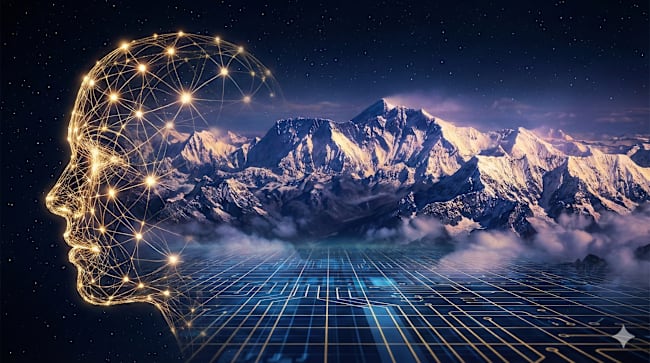
This article explores a fascinating convergence: modern neuroscience and ancient Advaita Vedanta philosophy both point to the same startling conclusion—that reality as we experience it is subjective, constructed by our minds rather than objectively “out there.” What’s remarkable is how cutting-edge AI research is now providing empirical evidence for what Indian sages declared thousands of years ago.
[!NOTE] I have included glossary at the end of the article to explain the different terms that span AI and Vedanta.
A Brief History of Intelligence
Evolution, AI and the Five Breakthroughs that made our brain
In this incredible book, the author Max Bennet explores the working of human brain. However, he approaches it from the point of view of neural networks.
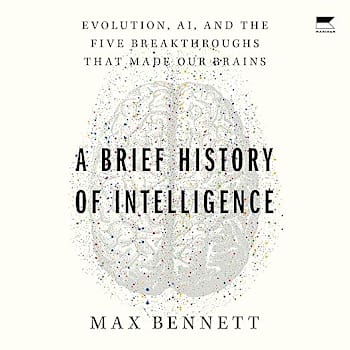
Until now, we’ve been trying to decode our brain. Often, we’ve hit road blocks. However, the world of AI has been rapidly progressing. Bennett’s central argument unfolds in two parts:
- If the brain is modeled based on neural networks and if we can observe the behavior of neural networks better than the brain, can we find similarities in the way they work?
- If we do find them similar, can the learning from one field help in the growth of the other?
He covers the vast gamut of how the brains evolved, starting right from single celled organism to the most complex beings. However, the point of this blog is one specific aspect—how does the brain perceive the world?
Senses & Perception
Perception - Classification Problem
We perceive the world around us through our senses. We think that we “see” things, “hear” sounds and so on. However, the reality is a bit more nuanced.
- light hits an object.
- light is reflected by the object.
- this reflected light hits light sensors in our eyes.
- some sensors detect lines, some detect edges
- these basic patterns are then “assembled” into a higher order shape
- the “assembled” information is passed on to brain
- the brain then does a “classification” and identifies this as an object like a book.
Perception - Generation Problem
The same problem can be re-framed as a “generation” problem. Our eyes detect something and through the noise, our brain “generates” an image of the world. All the other senses too do the same thing.
Let’s say I forget my specs. There is a book on a table about 10 feet away. I can barely “classify” it as a book. I may “hallucinate” and classify it as a book. My brain knows that books are normally kept here.
The other person predicts with a much higher probability.
These observations have profound implications for how we understand reality. Let us see how.
Objective vs Subjective Reality
Modern science long held that reality is objective—that things exist independently of consciousness. Things exist outside of the realm of “conscience” and individual perceptions. However, discoveries like uncertainty principle and quantum entanglement questioned this very assumption.
Based on the formulation of this book, it struck me that the author is basically saying that the so called “reality” is either a “classification” or a “generation”. In either case, we are “hallucinating” our reality. Since neural networks are stochastic (i.e. probabilistic), the same reality is perceived differently by 2 individuals.
Anecdotally speaking, this is simple to understand. In his book, the Seven Habits of Highly Effective People, Stephen Covey introduced this famous puzzle. In the same image, some people see a young woman while others see an old lady. So there are 2 realities that co-exist.
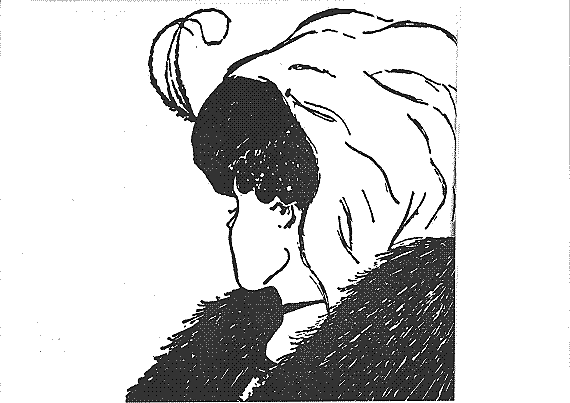
So we can agree that the same reality may appear different based on how our mind interprets it. Let’s look at another aspect - waking vs dreaming.
Waking vs Dreaming
We all know that our brain is hallucinating when dreaming. The whole story, the actors, the plot, the chase - everything exists in our mind. When we wake up, this reality vanishes.
However, if you carefully consider that our brain is always in the mode of classification/generation, there is actually no difference between waking and dreaming. Perhaps the difference is the amount of “hallucination”. In AI terms, we might say that waking life uses more constrained parameters, but the underlying generative process remains probabilistic. (Please refer to What is LLM Temperature for more details).
So, where is the link to advaita?
Waking, Dreaming and Reality
One of the highest Upanishads is called the Mandukya Upanishad. Advaita philosopers generally read this work based on the commentary called Mandukya Karika. It was composed by Sri Adi Shankara’s teacher’s teacher - Sri Gaudapaada.
According to the work, it starts with 3 states of awareness:
- Waking (Jagrat) - when both body and senses are active
- Dreaming (Svapna) - when only senses are active
- Deep Sleep (Sushupti) - when both senses and body are inactive
However, it starts to demolish these beliefs. In short, here’s what the work has to say.
- Both waking and dream are structured by a perceiving mind and consist only of appearances to that mind.
- Their objects lack enduring, independent reality; they arise and vanish like illusions.
- The only apparent difference is that dream objects seem “internal” and limited in space, while waking objects seem “external,” but this is not a difference in their truth‑status.
- Therefore, sages speak of waking and dream as essentially one more dream, superimposed on non‑dual consciousness. [Source: https://vedantastudents.com/mandukya-upanishad-with-shankara-bashyam-volume-6/]
Let’s understand this with a short story.
King Janaka - Dream or Reality?
story about King Janaka was known as a philosopher-emperor. One day, he wakes up from a very realistic dream. He ponders on whether the dream was real or the waking was real. His guru teaches him that the one reality present in both the dream and his awakened state is Janaka himself - so he is the only reality and everything else is false!
The same is proclaimed by a maha vakhya (great saying):
ब्रह्म सत्यं जगन्मिथ्या जीवो ब्रह्मैव नापरः। Brahman is real, the universe is mithya (it cannot be categorized as either real or unreal). The jiva is Brahman itself and not different.
Conclusion
Putting the two together, it is surprising that the empirical study of our brain and the working of neural networks are hinting at the same profound truth that Advaita Vedanta has proclaimed for millennia.
- Reality is perceived.
- Reality is subjective.
However, Advaita takes this one step forward and says the following:
- Although reality is subjective, the true “subject” is the ultimate reality.
- This true subject is the ultimate. In the Upanishad, it is known as the Brahman and in Mandukya, it is simply called the Turiya (the fourth).
What This Means for Our Future
This convergence between ancient philosophy and modern neuroscience isn’t merely an intellectual curiosity. It has profound implications for how we approach consciousness research and our understanding of existence itself.
If our brains truly operate as generative systems, constantly hallucinating our reality through classification and prediction, then the “hard problem of consciousness” i.e., why subjective experience exists at all—may need to be reframed entirely. Perhaps consciousness isn’t something that emerges from neural computation, but rather the fundamental substrate upon which all these computations occur. This is precisely what Advaita has always maintained: consciousness (Brahman) is not produced by the mind; the mind and all perceived reality arise within consciousness.
As AI systems become more sophisticated, we may find ourselves building machines that don’t just process information but generate rich internal models of reality, just like us. Will these systems develop their own form of subjective experience? Or will they reveal that what we call “subjective experience” is itself another layer of generation, another helpful illusion?
I am excited to see how research in AI progresses and whether this science continues to converge with ancient wisdom. Perhaps we’re on the verge of breakthroughs that will finally bridge the gap between the objective study of neural processes and the subjective nature of experience. The sages gave us the map thousands of years ago—we’re only now developing the scientific instruments to verify the terrain.
Glossary of Terms
Philosophy & Vedanta
Advaita Vedanta
A school of Hindu philosophy that teaches non-dualism—the idea that the individual self and ultimate reality are fundamentally one, not separate. “Advaita” means “not two.”
Brahman
In Hindu philosophy, the ultimate, unchanging reality that underlies all existence. It is pure consciousness itself, beyond all qualities and distinctions.
Guru
A spiritual teacher or guide who helps students understand philosophical and spiritual truths through direct instruction and wisdom.
Jagrat
The waking state of consciousness, when both body and senses are actively engaged with the external world.
Jiva
The individual soul or self as experienced in daily life. Advaita teaches that the jiva is ultimately identical to Brahman, though it appears separate due to ignorance.
Maha Vakya
Literally “great saying”—fundamental declarations found in the Upanishads that express core truths of Vedanta philosophy in concise statements.
Mandukya Karika
An ancient philosophical commentary on the Mandukya Upanishad, written by Gaudapada. It uses logic and reasoning to explain the nature of consciousness and reality.
Mithya
A Sanskrit term meaning “dependent reality” or “apparent reality.” Something that is mithya cannot be categorized as completely real (like Brahman) or completely unreal (like a unicorn). It appears real but depends on something else for its existence—like a mirage depends on light and sand.
Sushupti
The deep sleep state, characterized by the absence of dreams and sensory experience, yet a state of rest and peace.
Svapna
The dream state of consciousness, when the mind creates its own experiential reality without external sensory input.
Turiya
Literally “the fourth”—the state of pure consciousness that underlies and witnesses the three common states (waking, dreaming, deep sleep). It is consciousness itself, unchanging and ever-present.
Upanishads
Ancient Sanskrit texts that form the philosophical foundation of Hindu thought. They explore the nature of reality, consciousness, and the self through dialogues between teachers and students.
Science & Technology
Classification Problem
In artificial intelligence, the task of categorizing input data into predefined groups. For example, identifying whether an image contains a cat or a dog, or whether an email is spam or legitimate.
Generation Problem
In AI, the task of creating new content based on learned patterns. Modern AI systems like ChatGPT generate text, while image generators create pictures by learning from examples and producing new variations.
Hard Problem of Consciousness
A philosophical question posed by philosopher David Chalmers: Why do we have subjective, first-person experiences at all? Why does it “feel like something” to see red or taste chocolate, rather than these processes happening without any inner experience?
LLM Temperature
A parameter in large language models (AI systems) that controls how random or creative their outputs are. Lower temperature produces more predictable, focused responses; higher temperature produces more varied, creative responses.
Neural Networks
Computer systems designed to recognize patterns, inspired by how biological brains work. They consist of interconnected nodes (like neurons) that process information in layers, learning from examples to perform tasks like image recognition or language processing.
Quantum Entanglement
A phenomenon in quantum physics where two particles become correlated in such a way that measuring one instantly affects the other, regardless of the distance between them. This challenges our everyday understanding of how separate objects should behave.
Stochastic
Randomly determined or probabilistic, rather than fixed and predictable. A stochastic process involves some element of chance, like rolling dice or the random mutations in evolution.
Uncertainty Principle
A fundamental principle in quantum mechanics stating that certain pairs of properties (like position and momentum) cannot both be measured with perfect precision simultaneously. The more precisely you measure one, the less precisely you can know the other.